No 70-Foot Verizon Tower in our Backyard.
South Tucson · BOA 25-01 · A Procedural Review RequestThis site is a public record kept by neighbors. It is not a lawsuit and not a petition. It is a documented procedural review request asking the City of South Tucson to take a second look — at the findings, the notice, the floodplain jurisdiction, and the code amendments that happened along the way.
§ 01 · What Happened
The hearing ran 35 minutes. The vote was unanimous. One Board member said on the record that the agenda packet had not reached him until just before the meeting. Across the entire 33:46 audio recording, no Board member, no staff member, and no representative for the applicant addressed any of the seven findings the South Tucson Code requires before a variance may be granted.
The variance was processed as a setback adjustment under § 24-21, citing § 24-387(b)(12) — a 1970s-era enumeration provision for "radio broadcasting stations, towers and studios." The applicant of record is not Magnum Paving and not the parcel owner; it is a wireless siting representative.
§ 02 · Who is actually asking
The wireless siting representative who appeared at the February 25 hearing was not Magnum Paving. He was not the parcel owner of record (Hawesome Properties LLC). He was the agent through whom Verizon Communications, Inc. asked the South Tucson Board of Adjustment to grant a variance — so that Verizon could install Verizon's antenna on top of a new 70-foot pole, fund the host site through Verizon's lease, and expand Verizon's network footprint into a residential block where it does not currently sit.
Verizon, like every wireless carrier that applies for a variance, is responsible for the substance of its own application. The choice to pursue a new structure at a residential alley line — rather than co-locate on an existing FCC-registered taller pole half a mile away — was the applicant's choice. The choice not to put alternative-site analysis on the record was the applicant's choice. The choice to characterize a regulatory wash as "open space greenbelt parcel" was the applicant's choice. None of the City's procedural failures relieve the applicant of the duty to make the showings the law expects.
The asymmetry of resources and information access between a Fortune 50 wireless carrier and the residents of a 5,500-person Hispanic-majority enclave is itself part of what a Board of Adjustment is supposed to take into account — not bypass.
§ 03 · The host parcel
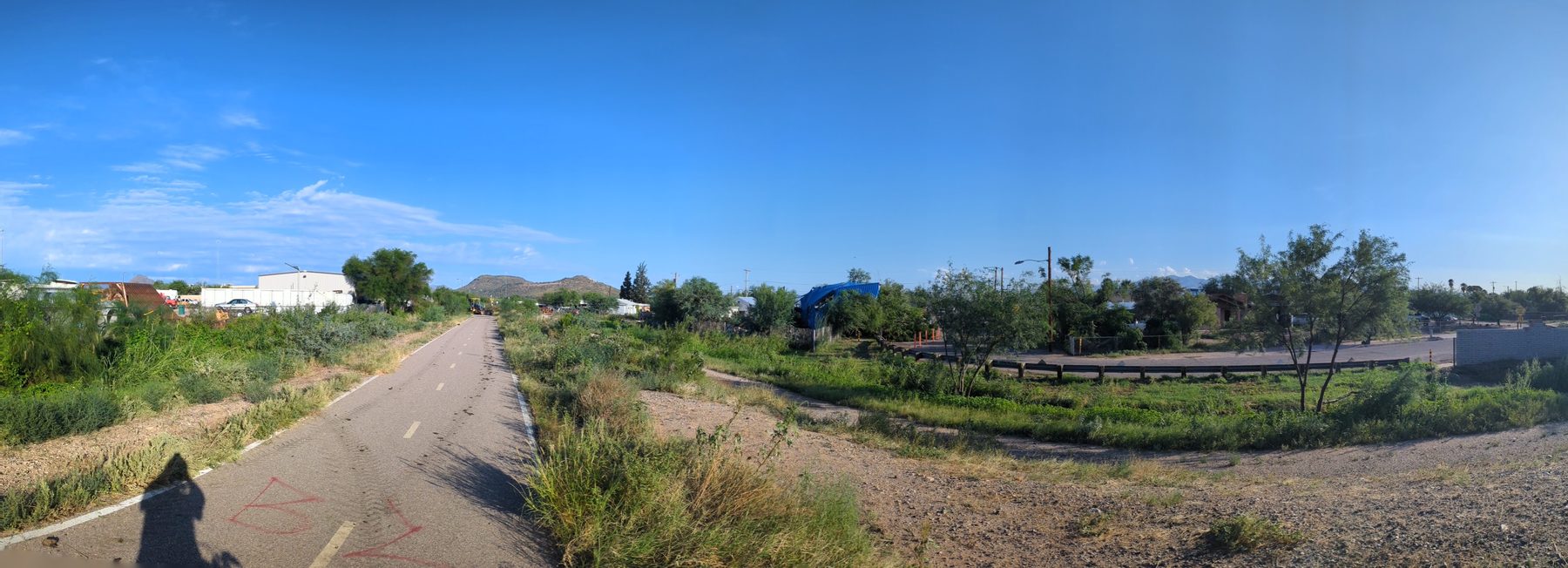
A timeline of 2425 S. 10th Avenue, the Magnum Paving lot, from the founding of the company in 1985 through the variance approved in February 2026. The August 2024 storm event is one of the things on this timeline. The seven required findings under § 24-21(c)(5) — that any variance "will not be detrimental to the public welfare nor injurious to other property or improvements in the neighborhood" — were not made on the record at the BOA 25-01 hearing.
March 1, 1985
Arizona for-profit corporation, ROC general commercial license A-099088 (and subsequent specialty licenses 119328, 076062). The company sets up paving operations at 2425 S. 10th Avenue, where it has remained for forty-one years.
1985 – 2024
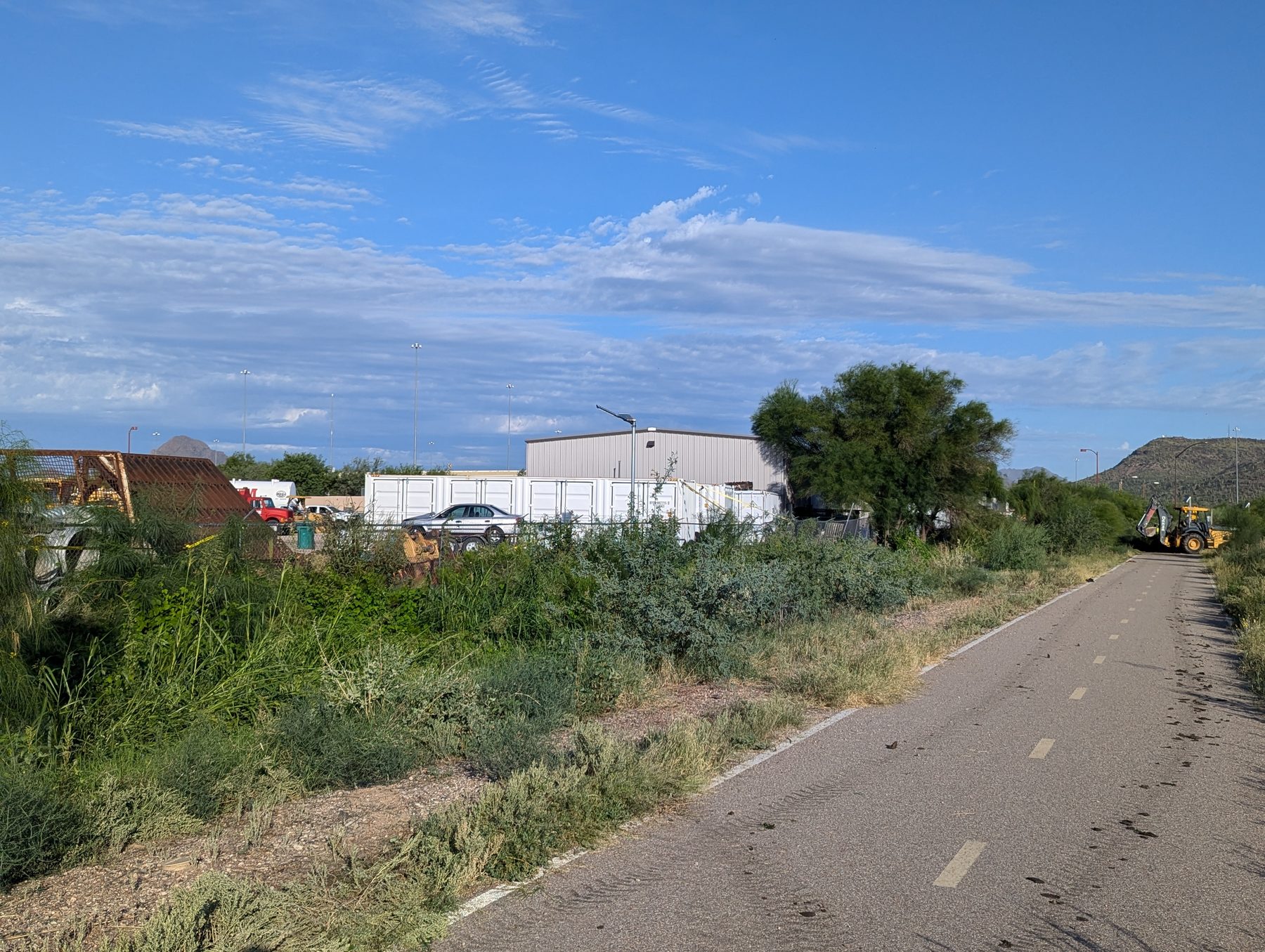
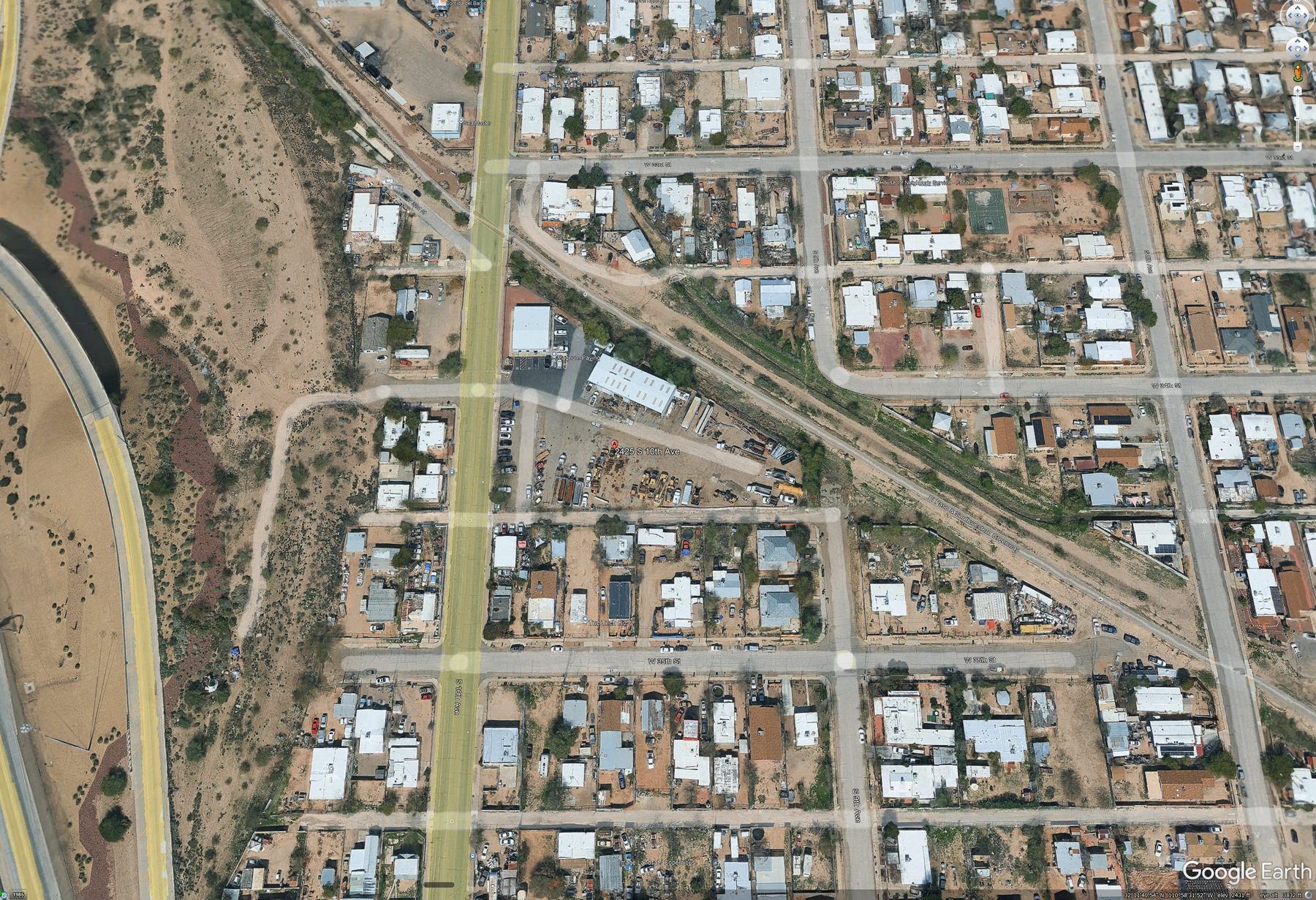
The 1.7-acre rectangular parcel runs heavy equipment, asphalt operations, drainage culverts. The block to the south is residential — single-family homes, mostly Hispanic-occupied, separated from the lot by a single alley. None of the surrounding homeowners bought their property expecting a 70-foot wireless tower in their viewshed; they bought next to a paving contractor.
At some point during this period a 20-foot by 60-foot A-frame metal roof structure is built on the parcel.
August 20, 2024
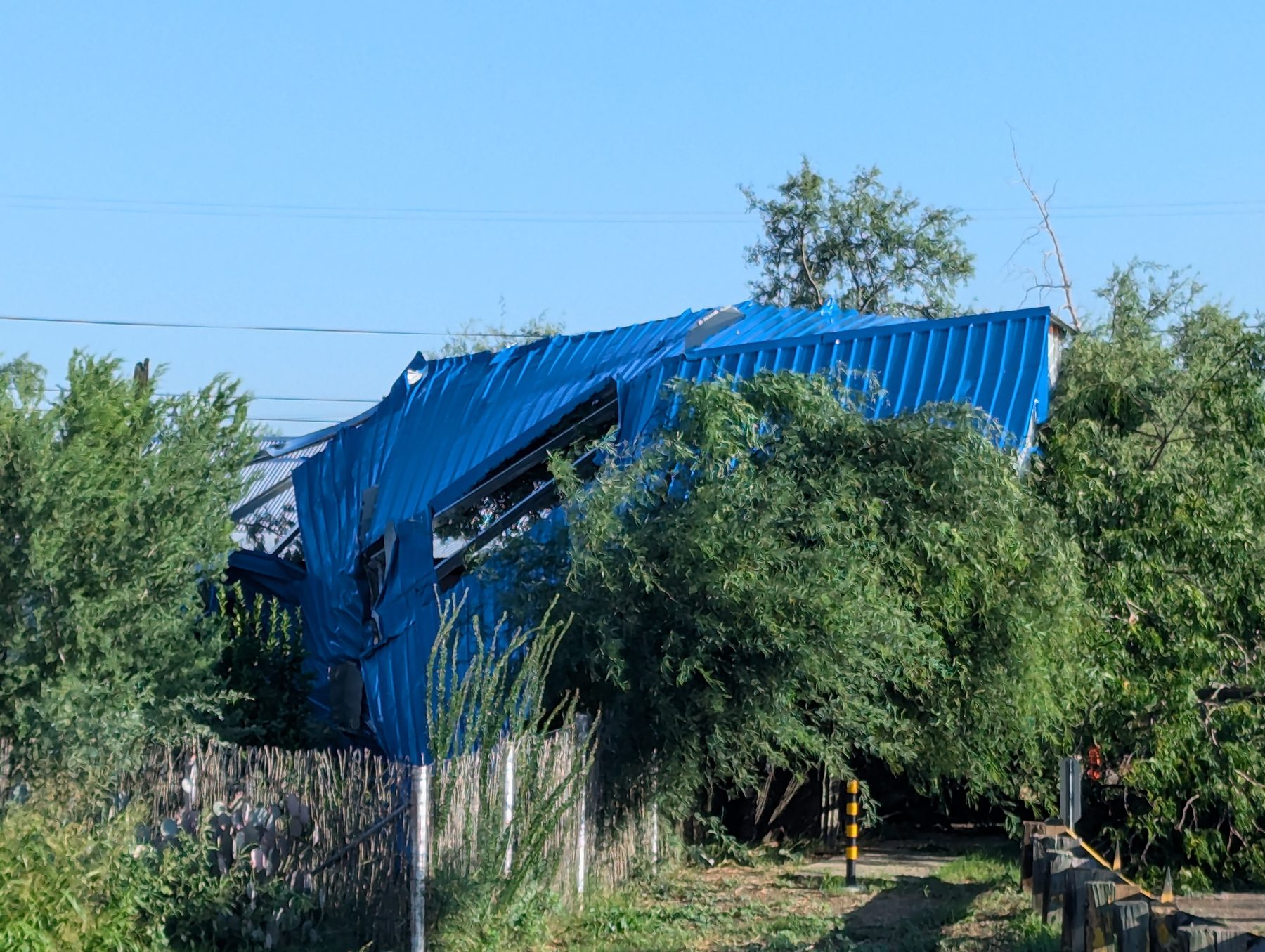
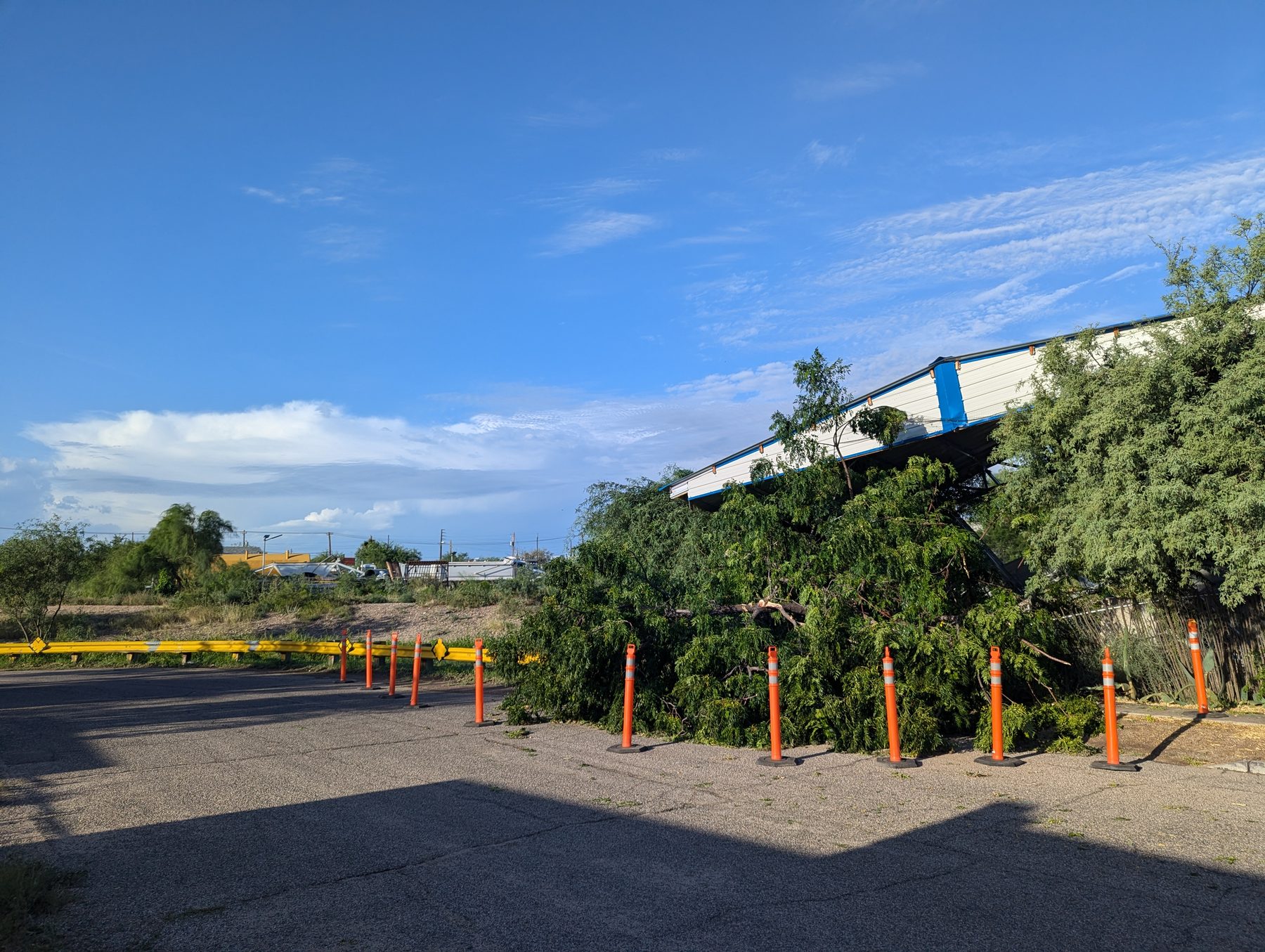
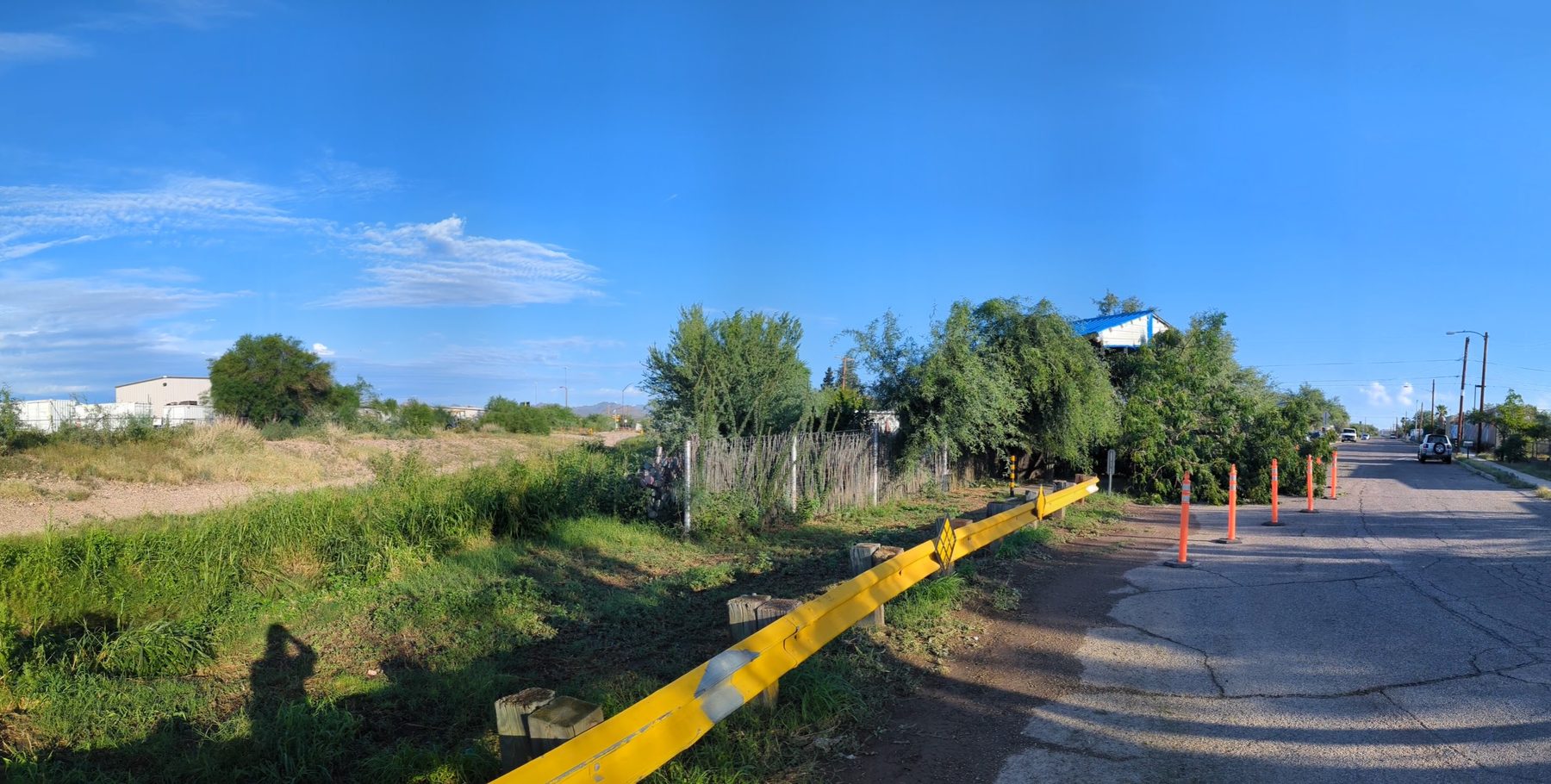
During a documented storm passing over Pima County, the entire 20-foot by 60-foot A-frame metal roof — including its supporting framing — is displaced from the Magnum Paving parcel. It comes to rest on the residence at 2320 S. 9th Avenue, damaging trees, fences, and a 1,000-gallon water tank. The homeowner's written statement, now part of the South Tucson Council public record, describes the event as one that "almost killed someone."
August 21, 2024 · 7:13–7:24 AM
Twelve photographs with EXIF and GPS metadata intact preserve the displacement trajectory. One image shows both the structure's original anchor location on the Magnum Paving parcel and its final resting position on the affected residence — fixing the trajectory on the record.
September 27, 2024
Six weeks after the storm event, title to 2425 S. 10th Avenue transfers from prior ownership to Hawesome Properties LLC. Pima County Recorder Sequence 20242710479. The LLC's mailing address is the same PO Box as Magnum Paving (PO Box 50562, Tucson AZ 85703-0562). The name combines "Haws" — Magnum's president — with "awesome."
October 12, 2025
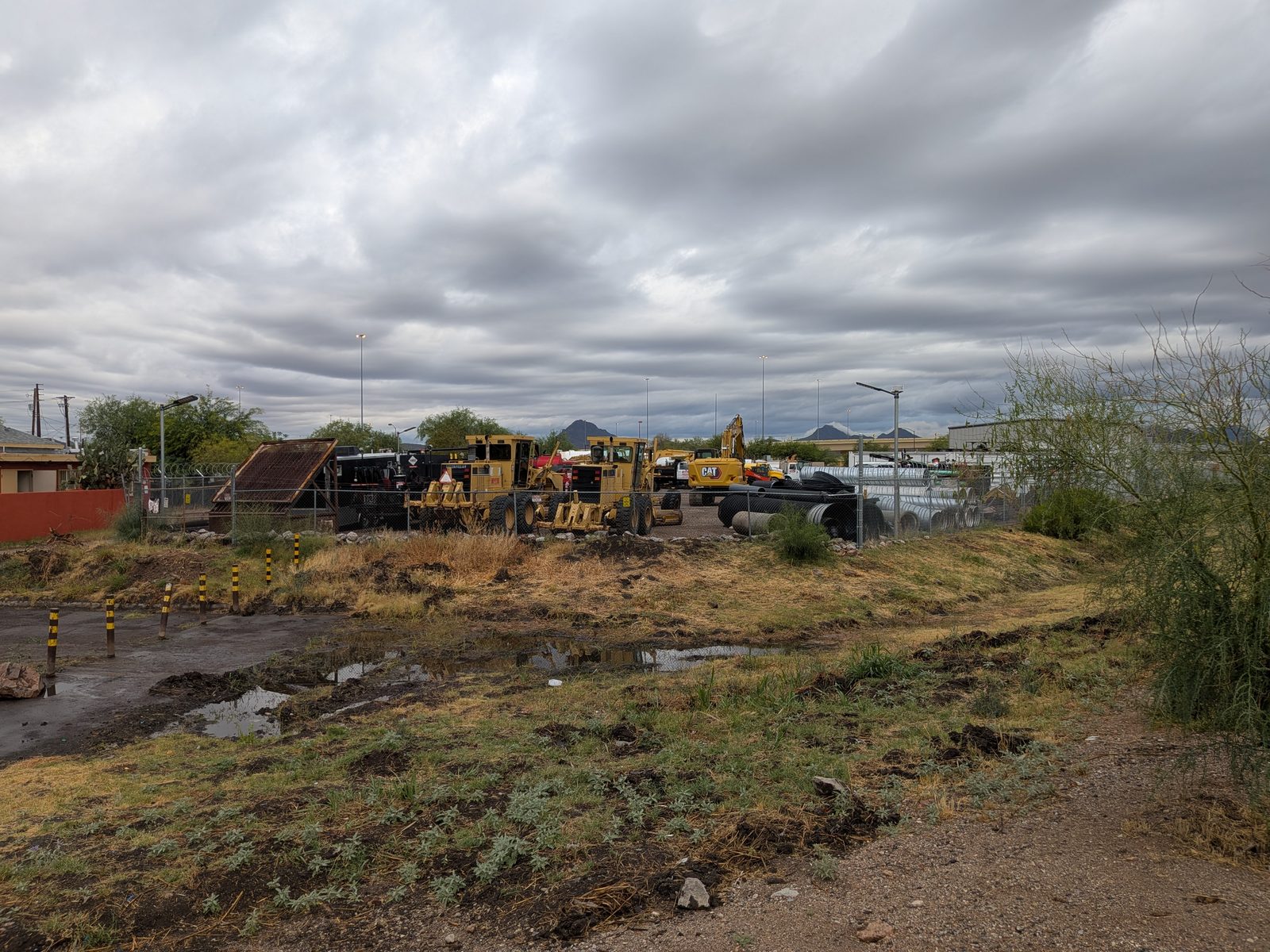
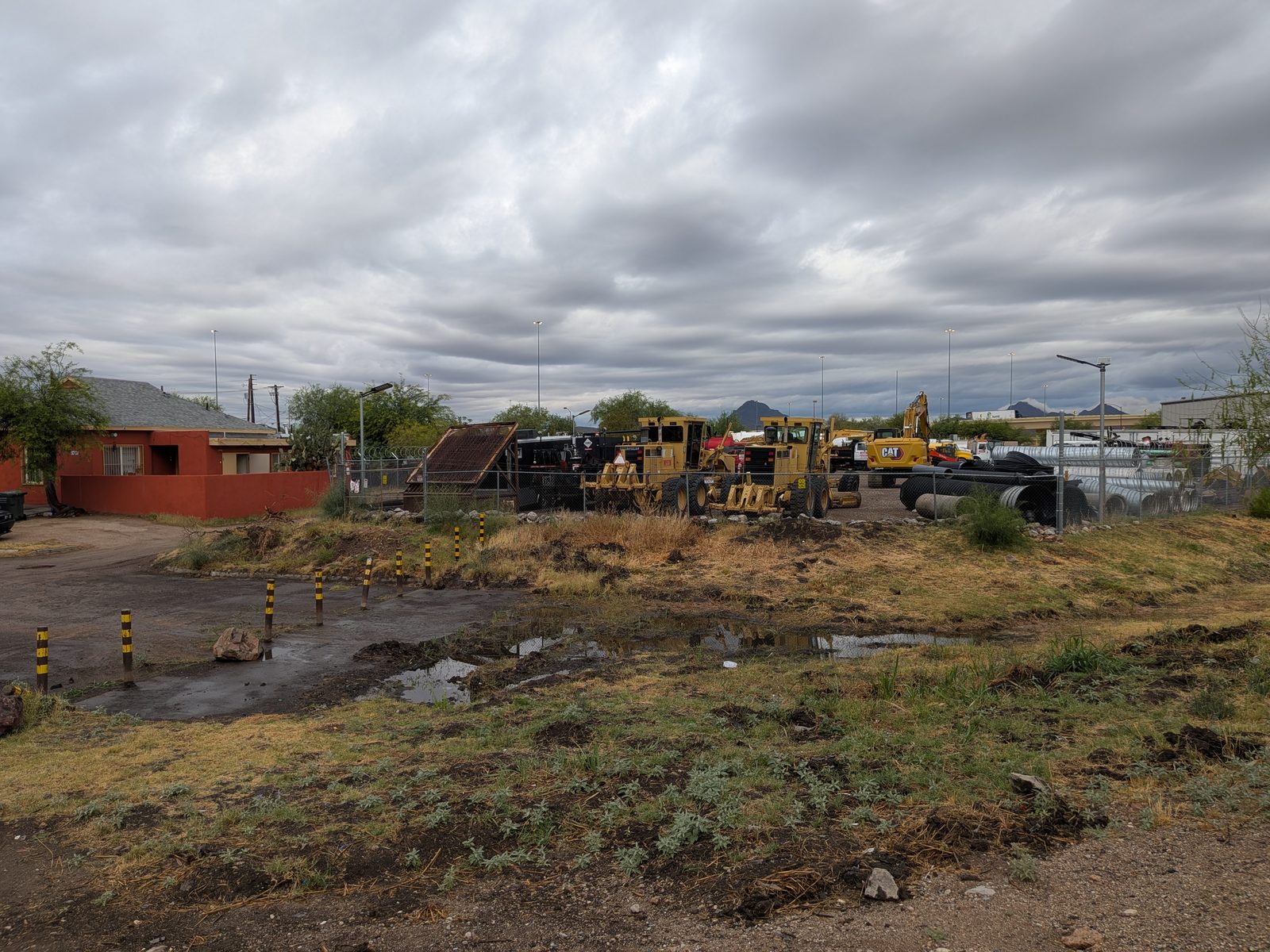
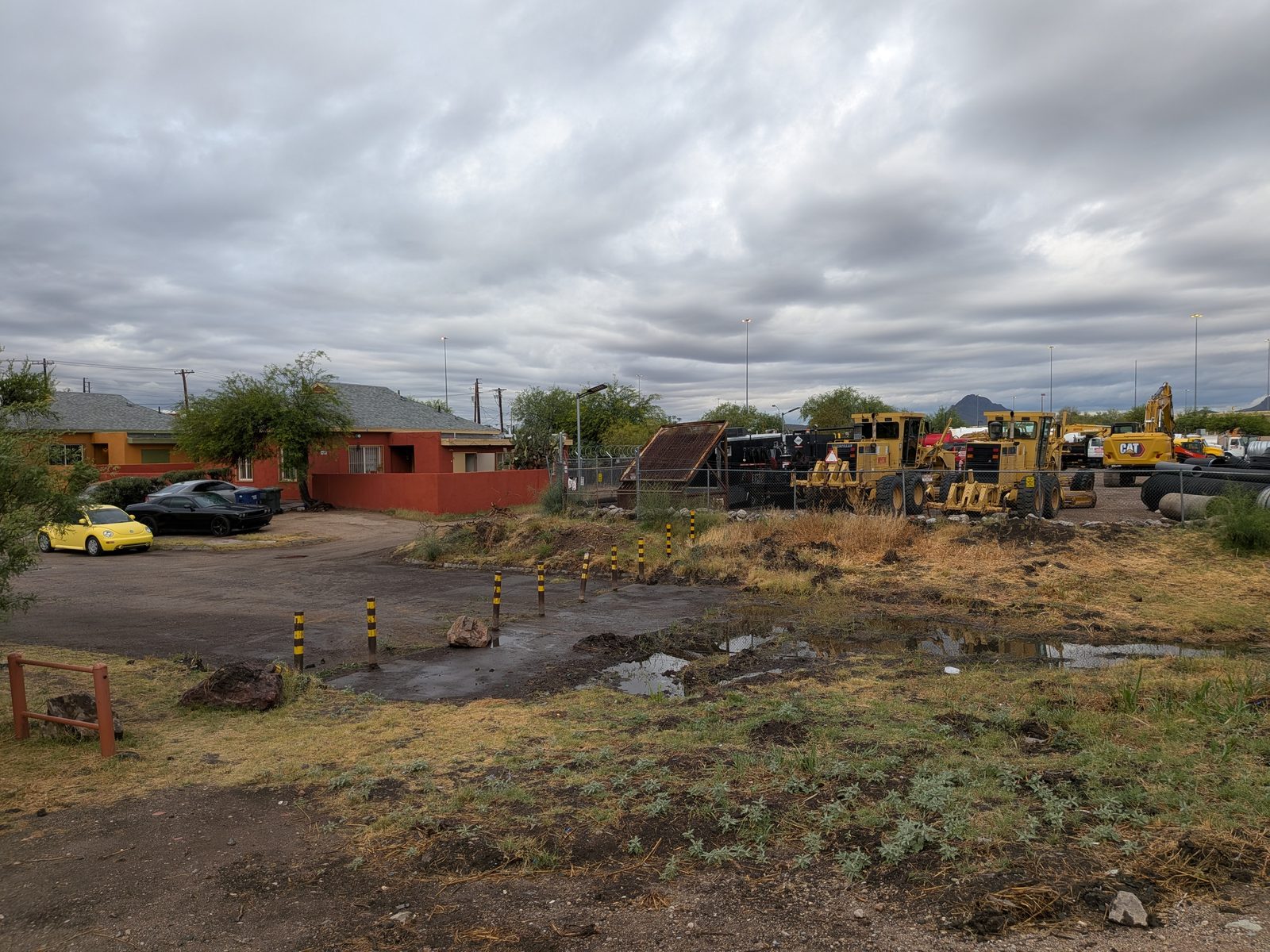
Photographic and video evidence documents standing water in the regulatory wash directly north of the parcel — the corridor that an applicant's representative would later characterize, in a different forum, as "open space greenbelt parcel."
Date pending — Public Records Request
When Verizon began identifying potential tower sites in South Tucson, when the property owner and the wireless siting representative first engaged on this parcel, when site survey and engineering work was performed, when application materials were prepared, and when the variance application was finally filed with the City — none of this is yet on the public record. The May 1, 2026 Public Records Request asks for the complete application file, all supporting materials, and the date-stamped intake. Until those records are produced, this part of the timeline remains a question.
February 25, 2026 · 3:04–3:39 PM
The South Tucson Board of Adjustment approves the variance in a 35-minute hearing. The 33:46 audio contains no mention of the August 2024 structure failure on the same parcel. The seven required findings under § 24-21(c) — including (5), the affirmative finding that the variance "will not be detrimental to the public welfare nor injurious to other property or improvements in the neighborhood" — are not made on the record.
§ 04 · The Procedural Record
This is procedural only. It is not a federally-preempted radio-frequency or health challenge — that line of argument is foreclosed by 47 U.S.C. § 332(c)(7), and the City Attorney correctly applied that preemption at the hearing.
Section 24-21(c) requires the Board to make seven affirmative findings before granting any variance — including no self-imposed hardship, no grant of special privileges, and no detriment to public welfare. Across the entire 33:46 audio, none of those seven findings were addressed by anyone.
§ 24-21(c) · 47 U.S.C. § 332(c)(7)(B)(iii)
The City Planner told the Board at hearing 16:05–16:42 that mailed notice went to "every property owner" within the 300-foot radius. Door-to-door visits with the City's own list — at the homes of approximately ten property owners reached in person — turned up approximately six who reported they had received no notice. The homeowner at 344 W. 35th Street, plainly within the radius, also received nothing.
§ 24-78 · A.R.S. § 38-431.02 · A.R.S. § 9-462.06
The City interpreted § 24-387(b)(12) — drafted before consumer cellular service existed in the United States — to encompass a 2026 cellular facility. Federal law treats broadcasting (47 U.S.C. § 301 et seq.) and personal wireless services (47 U.S.C. § 332) as distinct regulatory categories. The Board of Adjustment is barred from granting use variances under § 24-21(a). The proper remedy is a zoning text amendment by the City Council under § 24-43.
§ 24-387(b)(12) · § 24-2(c) · § 24-21(a) · § 24-43
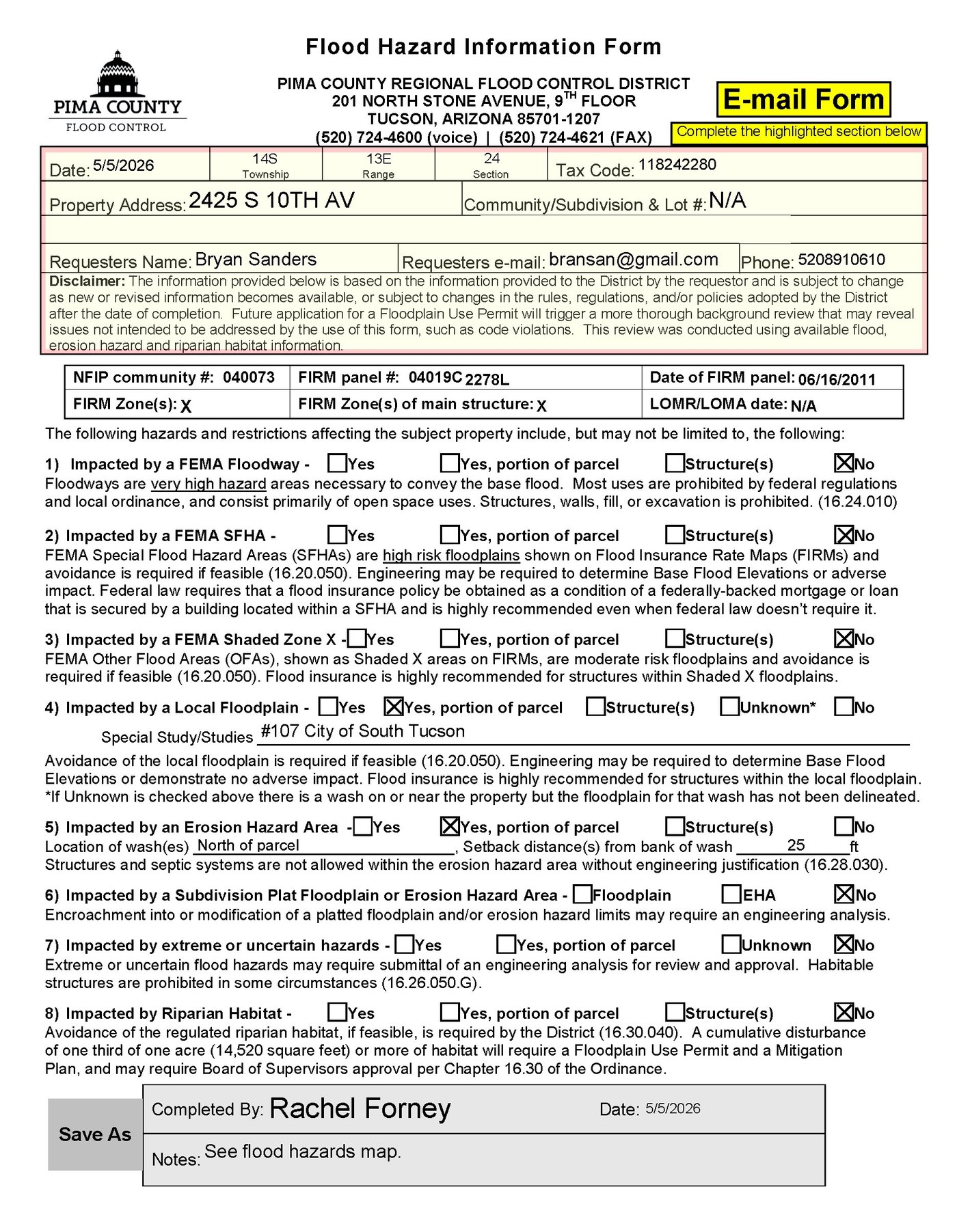
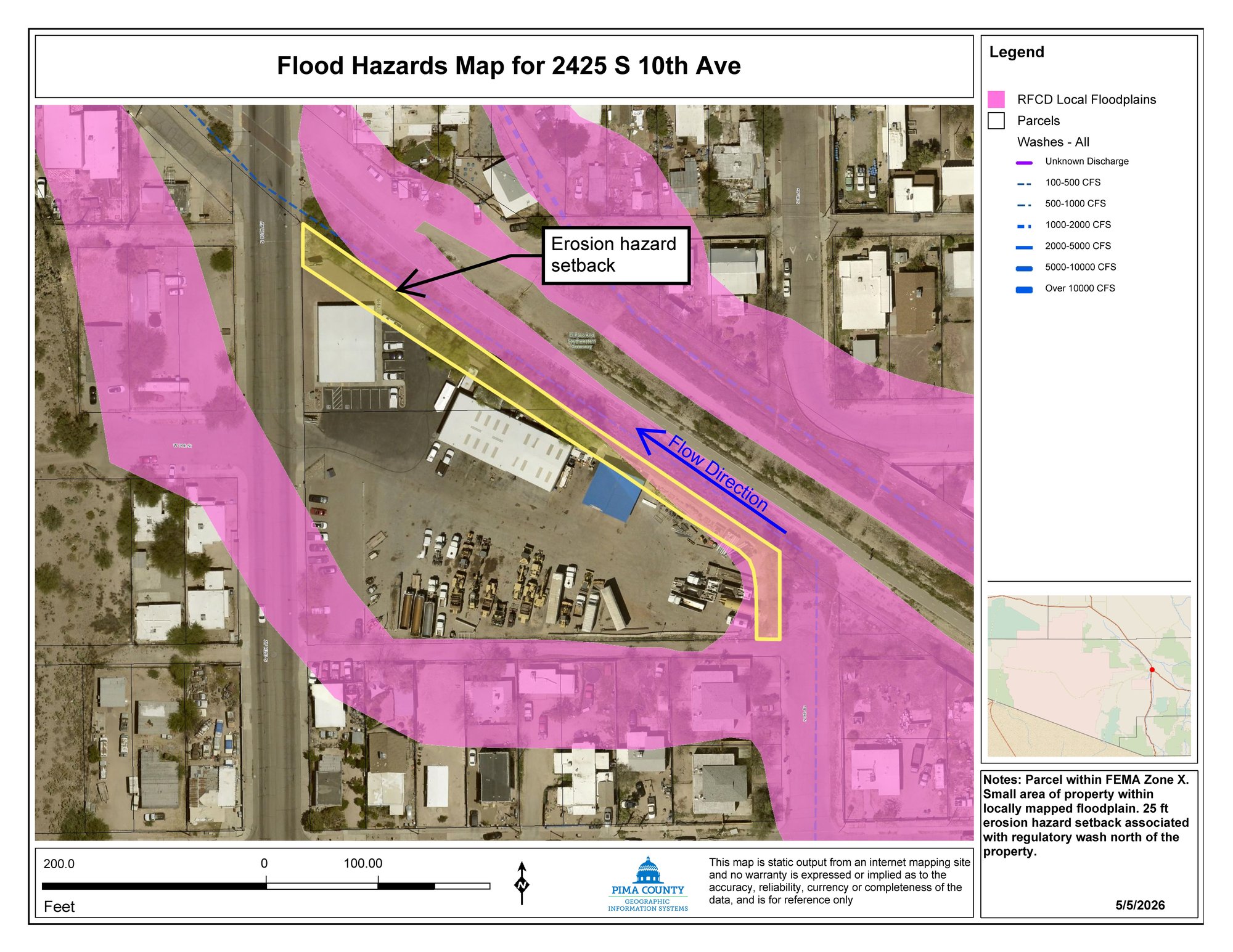
On May 5, 2026, Rachel Forney of the Pima County Regional Flood Control District Chief Engineer's office signed a same-day Flood Hazard Information Form determining that a portion of the parcel sits in regulatory Local Floodplain (Special Study #107, § 16.20.050) and Erosion Hazard Area, with the active wash directly to the parcel's north requiring a 25-foot setback under § 16.28.030. At the hearing, the applicant's representative described that exact corridor as "open space greenbelt."
PCRFCD · Title 16 · § 16.20.050 · § 16.24.050 · § 16.28.030
§ 05 · The Zoning Code Question
This is structurally different from how the variance was handled. It is a question about the rules themselves — about whether residents and applicants can rely on the version of the zoning code published by the city.
Two versions of South Tucson Chapter 24 are publicly available right now. Seven defined terms appear in the August 2025 version of § 24-1 and do not appear in the April 2026 version.
The City Attorney has stated that the apparent differences between published versions of the code are an artifact of the city moving from one code-publishing vendor to another, and that no substantive change to the operative code has occurred.
These follow from the observable facts. They are not accusations — they are the questions any code-amendment process would be expected to answer in the ordinary course.
What is the operative text of § 24-1 today — are the seven terms part of the code, or not?
Residents and applicants in South Tucson rely on the published version of the code. There should be one version that is the operative version, and it should be the one the city publishes.
If the seven terms are still operative, why is the version on the city's website not the operative version?
A vendor migration would not remove operative defined terms — it would carry them forward. Different formatting is one thing; missing definitions is another.
If the seven terms are not operative, what ordinance changed them?
§ 24-43 requires that any amendment to Chapter 24 proceed through Planning Commission review and Council adoption with public hearing. We are asking for the ordinance number, the date of introduction, and the date of adoption.
Was there a Planning Commission review?
If yes, the record should reflect it. If no, the amendment did not follow § 24-43.
Was there a public hearing?
Same standard. The Planning Commission and Council records should show it.
The April 2026 version on the city's website shows no amendments to Chapter 24 anywhere after 2017. Is that accurate?
If Chapter 24 has not been substantively amended since 2017, that should be straightforward to confirm from Council meeting minutes. If it has been amended in the intervening eight years, those amendments should be visible in the published version.
Did the change in code-publishing vendor involve any substantive changes to the published text — or only formatting?
This is a publishing-process question with a documented factual answer. A clear written description of what changed and what didn't would resolve much of this section.
A clear, document-supported answer to questions 1 through 7. That is all.
Item 6 of the May 1, 2026 Public Records Request specifically seeks any ordinance amending Chapter 24 between 2017 and the present, along with the Planning Commission record and the Council adoption record.
§ 06 · The Bigger Picture
Zoning laws are among the most consequential laws on the books. They redirect floodwater. They reshape neighborhoods. They determine what gets built across the alley from your home. A Board of Adjustment exists to apply those laws case-by-case, with care — when literal application would cause genuine hardship. It is not a rubber stamp.
The Board of Adjustment is a check, not a bypass. It is supposed to provide careful, fact-bound scrutiny when applying the zoning code in literal terms would produce an unjust outcome — a parcel with unusual physical conditions, a self-evident gap in the code's coverage, a hardship not of the property owner's making. It exists precisely because zoning laws are powerful, and powerful laws need case-by-case attention when they meet the edge cases.
That role becomes more important, not less, when the relief sought would materially change a neighborhood's character. The Board is supposed to engage that change on the public record. It is supposed to hear from neighbors. It is supposed to ask whether the change is appropriate for the area, whether it imposes a detriment on the public welfare, whether it grants special privileges, whether the relief is the minimum necessary. None of those questions were addressed at BOA 25-01.
The Magnum Paving lot at 2425 S. 10th Avenue has operated as a paving contractor's yard since 1985 — 41 years. The block around it has been residential the entire time. Magnum Paving is the only commercial operation on this side of the street. None of the homeowners on the block bought their properties expecting a 70-foot wireless tower in their viewshed. None of them built their homes anticipating one.
What is actually being asked of the Board, under the cover of a "setback variance," is permission for a 41-year paving contractor to enter an entirely new line of business: hosting a 70-foot wireless tower for Verizon. That is not a marginal change to an existing operation. That is a transformative change in what the parcel does and how it interacts with the neighborhood.
The Board of Adjustment cannot grant use variances. Section 24-21(a) of the South Tucson Code expressly reserves use changes for the City Council under § 24-43, which requires Planning Commission review and a public hearing. Setback variances are properly within the Board's authority — but they require all seven findings under § 24-21(c) to be made on the record.
At the February 25, 2026 hearing, the applicant's representative described the relief sought as setback relief on north and east property lines. Verbatim from the audio at 30:08–30:31: "we're asking for relief on the north and east property lines to allow us to abut it closer to that open space greenbelt parcel."
In a subsequent meeting before the City Council, however, the City Attorney has asserted that the variance was in fact a use variance.
Either characterization is a problem. If it was a setback variance — as the applicant said on the record — then the seven findings under § 24-21(c) had to be made and were not. If it was a use variance — as the City Attorney now asserts — then the Board of Adjustment had no jurisdiction at all, and the proper path under § 24-43 (Council action with Planning Commission review and a public hearing) was not followed.
The actual application paperwork would resolve the question. It is among the records requested in the May 1, 2026 Public Records Request, pending response.
An operational change of this magnitude requires careful examination of the impact on the neighborhood, of the alternative sites available, of the variance findings the law requires. The 33:46 hearing audio engaged none of those things. The discussion that did occur was about matters that cannot legally support the variance — including a description of the regulated wash north of the parcel as "open space greenbelt parcel."
The fact that the parcel is zoned SB-2 does not mean any conceivable commercial activity is permitted there as of right. SB-2 enumerations were drafted in language broad enough to cover a range of activities — but their interpretation in 2026 has to account for the actual character of the neighborhood, the actual nature of the proposed use, and the actual record of impact. The Board and the Council exist precisely to step in and say, when appropriate, "the zoning category alone is not enough."
The block is residential. The parcels surrounding Magnum on the south, east, and west are single-family homes. There is no other business on this side of the street within view. Whatever Magnum's grandfathered status under earlier zoning codes, the current reality is a contractor's yard inside a residential neighborhood. A 70-foot wireless tower compounds that mismatch — it does not resolve it.
§ 07 · The Co-location Question
Federal and state law on wireless siting consistently encourage co-location — placing new wireless equipment on existing structures rather than building new ones. It is the standard expected analysis. It exists precisely to prevent scenarios like this one: a new 70-foot pole at a residential alley line when an existing taller pole sits half a mile away.
An 80-foot Sun State Towers monopole already exists at 2675 S. Santa Cruz Lane, 0.6 miles west-southwest of the Magnum site. It is FCC-registered (ASR 1325714), FAA-cleared (FAA Study 2023-AWP-8714-OE), and ten feet taller than what Verizon proposes to build at the alley. Co-location on that existing structure would have eliminated the need for a new tower entirely.
The seventh finding required by § 24-21(c) is that the variance be the minimum necessary. If a viable co-location alternative exists 0.6 miles away on an existing taller structure, then by definition no variance is the minimum necessary. The applicant did not need a setback exception. The applicant needed to put their antenna on an existing pole.
This isn't a procedural footnote. It goes to the heart of the variance analysis. A finding that the relief is the minimum necessary cannot be supported by a record that contains zero discussion of the more restrained alternative sitting on an FCC-registered, FAA-cleared, taller structure half a mile away.
Co-location reduces visual impact, reduces structural failure surface area, reduces ongoing maintenance footprint, and avoids the cumulative effect of multiple new structures across a small geographic area. Federal wireless-siting law, FCC guidance, and standard local-government ordinances across Arizona all encourage or require co-location analysis as part of any new-tower application. The expectation is that an applicant will demonstrate, on the record, that no viable existing structure was available — before a new structure can be approved. That demonstration was not made here.
An on-the-record co-location analysis as part of any reconsideration of BOA 25-01: which existing FCC-registered structures within the relevant coverage radius were evaluated, with what engineering input, and on what basis a new structure was deemed necessary. This is the analysis the Board should have seen before voting.
§ 08 · Evidence
The corridor north of the parcel was described to the Board on the public record as "open space greenbelt parcel." Five months later, the Pima County Regional Flood Control District signed a same-day determination establishing that the parcel sits in regulatory Local Floodplain (Special Study #107 — City of South Tucson) and that there is a regulatory Erosion Hazard Area setback of 25 feet from the bank of the wash directly to the north.
"We wanted to be sensitive to setbacks into the neighborhood. So the site location of this is we're asking for relief on the north and east property lines to allow us to abut it closer to that open space greenbelt parcel." — Verizon's siting representative to the Board, hearing audio 30:08–30:31
The morning the determination was signed, after a routine spring rain — not a storm event. Standing water in the linear depression directly against Magnum Paving's north property line. EXIF GPS metadata preserved.
§ 09 · Timeline
A 20-by-60-foot A-frame metal roof was projected from the Magnum Paving lot onto a neighboring residence at 2320 S. 9th Avenue during a thunderstorm. Twelve EXIF/GPS-locked photographs document the trajectory.
Six weeks after the August storm event, title at 2425 S. 10th Avenue moves from Magnum Paving to Hawesome Properties LLC (Pima County Recorder Sequence 20242710479).
A side-by-side comparison of the Munipodes archive against the city's April 2026 PDF documents the difference: Antenna, Collocation, Communication-commercial-wireless, Communications, Communications-facility-wireless, Conceal, and Disguise. The window includes the BOA hearing date.
Across the full 33:46 audio recording, no Board member, staff member, or applicant representative addresses any of the seven findings § 24-21(c) requires.
A second flood event at the same parcel boundary, 14 months after the August 2024 incident.
PRR filed with the South Tucson City Clerk seeking the notice mailing list, proof of mailing, the staff report, and any Chapter 24 amendment ordinance and Planning Commission record. Stamped clerk's copy retained.
Rachel Forney of the PCRFCD Chief Engineer's office returns a same-day determination on the parcel: regulatory Local Floodplain, Erosion Hazard Area, 25-foot setback from the wash bank.
Procedural review request packages delivered to the South Tucson Mayor and Council, to Pima County Supervisor Matt Heinz (District 2), and to the Arizona federal delegation. The 6:00 PM Council meeting was the first agendization opportunity.
Under A.R.S. § 9-462.06(K), an aggrieved person has 30 days to appeal a Board of Adjustment decision to Pima County Superior Court for de novo review, running from the date the BoA's written decision was filed.
§ 10 · The Documentary Record
These are the procedural review request packages delivered to elected officials and the press on May 5, 2026, plus the Pima County floodplain determination. The full archive — hearing audio, transcripts, EXIF-locked photographs, the side-by-side code diff, the records request — is available on request.
Why Tucson has a regional stake in an adjacent municipality's procedural review — floodplain continuity, comparative WCF practice, civil-rights resonance.
Download PDF (40 KB)Procedural concerns addressed to Senators Kelly & Gallego and Representative Adelita Grijalva (AZ-07), in whose district this falls.
Download PDF (45 KB)The hooks, the visuals, the news peg, and what this story is not — including the email-body version for cold pitching.
Download PDF (43 KB)Ten-slide visual companion built for the May 5 Council meeting. Civic-navy palette, restrained typography, the floodplain map as the hero slide.
Download PDF (459 KB)The signed determination from PCRFCD Chief Engineer's office establishing regulatory Local Floodplain and Erosion Hazard Area on the parcel.
Download PDF (1.9 MB)Two-page handout for journalists: the headline, the five things on the public record, what a Board of Adjustment is for, and the co-location question. Includes site photos and the floodplain map.
Download PDF (660 KB)Full 33:46 BOA hearing MP3, timestamped transcript, 42-item public records request with stamped receipt, neighbor statements documenting non-receipt of notice, EXIF-locked flood photos. Email below to request.
Email Bryan to request§ 11 · How to Help
This isn't a fundraiser. It isn't a petition. It's a request that City Hall take a documented second look at one variance — and that the people most affected know what happened and have a chance to be heard.
South Tucson Council holds Regular Agenda Meetings the 1st and 3rd Tuesdays at 6:00 PM, 1601 S. 6th Avenue. Public comment is open. A short, calm note from a neighbor saying "please review BOA 25-01 procedurally" carries weight that an attorney's letter cannot.
If your address sits within 300 feet of 2425 S. 10th Avenue and you didn't receive a mailed notice for the February 25 hearing, please email Bryan. The pattern matters.
South Tucson is an enclave entirely surrounded by Tucson. Stormwater, neighborhoods, and civic standing all spill across the border. Tucson's voice — even an informal one — would carry.
Hearing audio, signed County determination, EXIF-locked photographs, public records request with stamped receipt — all available. Site walkthroughs welcome.
The variance is being pursued by two specific entities: Verizon Communications, Inc. as the wireless carrier and corporate beneficiary, and Magnum Paving as the host parcel operator. Either of them could withdraw their support for the variance at any time. Calls and emails — civil, fact-based, identifying yourself — go on the public record and are part of how citizens engage with corporate decision-making.
Verizon Communications, Inc.
Customer Service: 1-800-922-0204
Corporate HQ: (212) 395-1000
Suggested ask: "I'm calling about Verizon's variance application for a 70-foot wireless tower at 2425 S. 10th Avenue in South Tucson. There is an existing FCC-registered 80-foot pole half a mile away — FCC ASR 1325714. Will Verizon withdraw the variance application and pursue co-location at that existing structure?"
Magnum Paving
Steve Haws (President): (520) 441-8988
Email: Steve@magnumpaving.com
Suggested ask: "I'm a neighbor / Tucson resident calling about the proposed Verizon cell tower at 2425 S. 10th Avenue. Will Magnum Paving withdraw its support for the variance and consider an alternative site that does not place a 70-foot tower at the alley line of a residential block?"
One ground rule. This is civic engagement, not harassment. Identify yourself, state your concern in one sentence, ask a specific question, thank whoever takes the call. Don't yell, don't repeat-call, don't show up uninvited. Volume of calls plus discipline is what makes the public record visible — anything else gets the request dismissed and harms the case.
This isn't an RF/health argument and it isn't anti-infrastructure. It's a procedural review based on the public record. Pro bono guidance, amicus consideration, or a half-hour phone call would all be valuable.
In one sentence:
That the City of South Tucson take a documented second look at BOA 25-01 — the seven required findings, the notice question, the floodplain jurisdiction, and the published text of § 24-1 — on the public record, with the documents in hand.